
Aphasia
In this article
Aphasia is a language problem, not a thinking problem
This is the single most important thing to understand about aphasia, and the thing families most often get wrong in the first weeks.
Aphasia damages the brain’s language system. It does not damage intelligence, memory for who people are, judgment, humor, or personality. The person who cannot find the word for “coffee” still knows exactly what coffee is, still has opinions about how they take it, and is very likely aware that the word will not come. That gap between what a person knows and what they can say is the frustrating center of this condition.
People with aphasia are frequently talked over, talked about in the third person while sitting in the room, and assumed to be confused. They are not. They are competent adults with a specific communication impairment.
What causes it
Stroke is by far the most common cause. A systematic review and meta analysis of 50 studies found aphasia in a median of 30% of patients in acute stroke settings and 34% in inpatient rehabilitation settings (Flowers et al., 2016). Studies that tracked the same patients across a year reported frequencies 2 to 12 percentage points lower than at baseline, meaning some people recover to the point of no longer meeting criteria and many do not.
So roughly a third of people have aphasia in the early period after a stroke. That figure varies quite a bit with stroke type and with where and when the assessment happens, which is part of why the numbers you find online disagree with each other.
Aphasia can also follow traumatic brain injury, brain tumors, brain infections, or surgery.
There is also primary progressive aphasia, a form of frontotemporal dementia in which language declines gradually rather than appearing suddenly. Treatment for PPA looks different from treatment after a stroke, and the goals are different, but it is not a condition where nothing can be done.
What aphasia looks like day to day
Aphasia affects four things, in different combinations and to different degrees in every person.
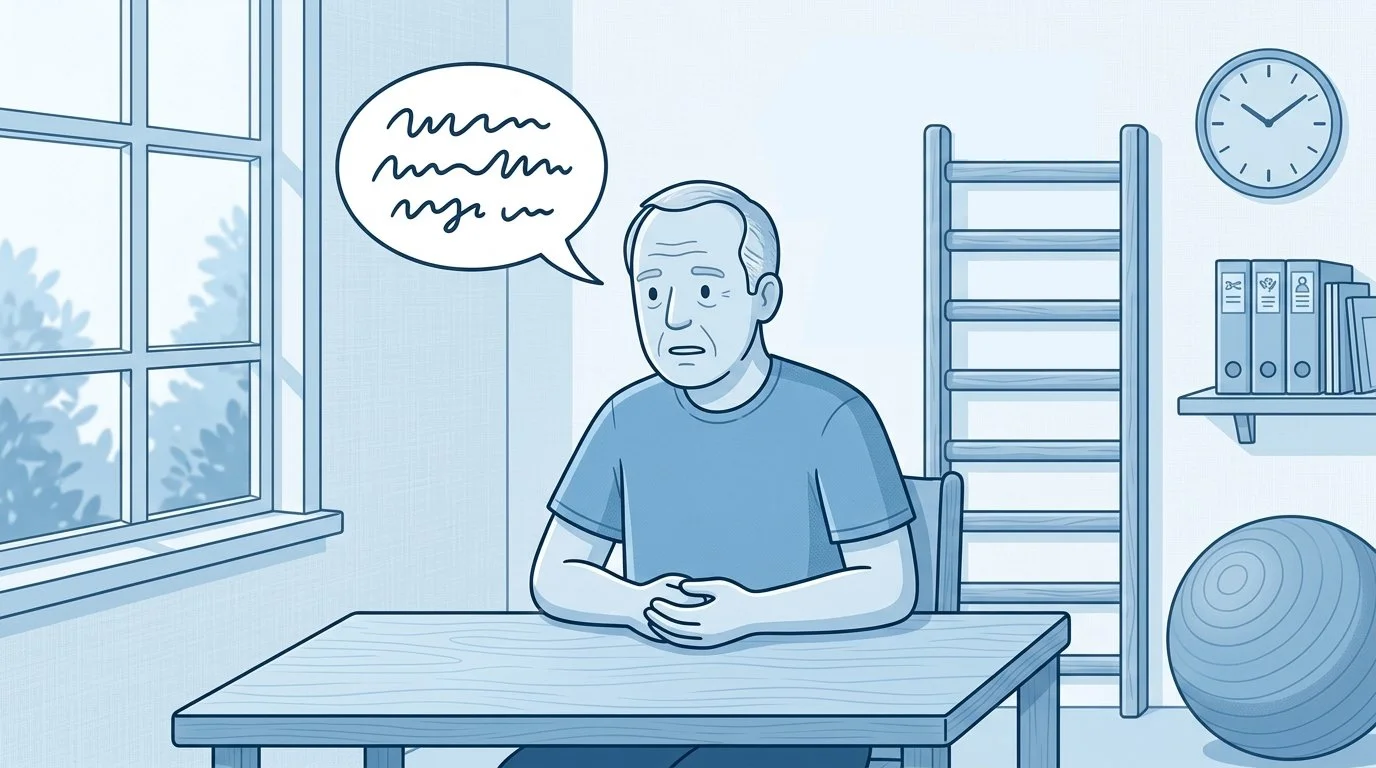
Speaking. Difficulty retrieving words, producing short or effortful sentences, saying one word when another was intended, or producing fluent speech that does not carry the intended meaning.
Understanding. Trouble following conversation, especially when it is fast, in a noisy room, or coming from more than one person at once.
Reading. Difficulty with text that was easy before, from medication labels to email.
Writing. Difficulty spelling, composing a message, or filling out a form.
Some people have mostly word finding trouble with strong comprehension. Some understand very little but speak fluently. Some are affected in every area. The pattern matters, because it drives what treatment should target.
What to expect from an evaluation
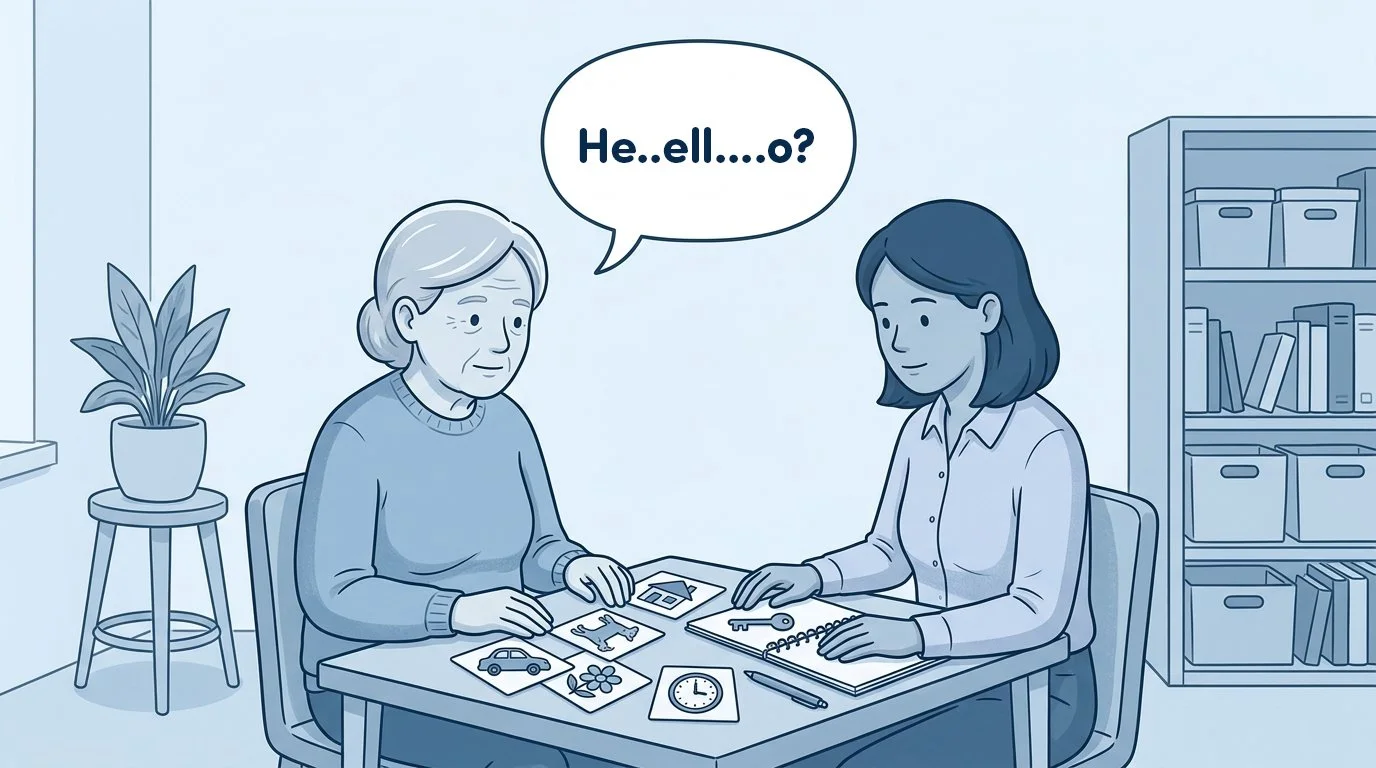
Care starts with an initial evaluation. It combines formal assessment of speaking, understanding, reading, and writing with an interview with the person and their family or caregiver about how communication is going day to day and what they most want to get back.
Family members are welcome and encouraged to attend.
How aphasia is treated
There is no single protocol. A reasonable plan usually blends several of these.
Impairment based treatment. Direct work on the broken machinery, such as semantic feature analysis for word retrieval or structured practice on sentence production. This is where measurable gains in language ability come from.
Functional and life participation treatment. Building the specific communication a person needs for the specific life they want back. Script training, where we build and drill a handful of conversations that matter to that person, is often the fastest route to something that feels like a real win.
Communication partner training. Teaching the spouse, the adult children, the caregiver how to talk with someone who has aphasia. Slowing down, writing down key words, asking yes and no questions, giving time, confirming the message. This is one of the highest yield things we do and it is chronically underused.
Supported communication and AAC. Communication boards, apps, writing, drawing, photos. Using these does not mean giving up on speech. It means the person gets to participate while speech is being rebuilt.
Home practice. Frequency and intensity matter more in aphasia than in almost any other area we treat. Sessions set the direction. Practice between sessions is where the change happens.
About the progress plateau
Many people arrive here having been told, often a year or more ago, that they had plateaued and therapy was finished.
Recovery is fastest in the first months, and that is real. But the idea that improvement stops at six or twelve months has not held up under controlled testing. People with chronic aphasia make measurable gains that hold up over time when therapy is intensive and targeted at language they actually use (Breitenstein et al., 2017; Palmer et al., 2019; Rose et al., 2022).
Being told you plateaued usually meant an episode of care ended, not that your brain stopped being capable of change.
If it has been a while, it is worth an evaluation.
Aphasia in Spanish and in two languages
Aphasia affects each of a bilingual person’s languages, and often not equally. Assessment in English alone can badly misrepresent what someone is capable of, and therapy in a language a person does not live their life in tends not to transfer.
Evaluation and treatment are available in English and Spanish.
Where therapy happens
Services are available at the Arvada clinic and by telehealth anywhere in Colorado, so living outside the Denver metro is not a barrier to getting started. Aphasia therapy translates well to video for most people, a family member or caregiver can join from wherever they are, and it puts Spanish language aphasia therapy within reach of parts of the state where it is otherwise hard to find.
Home visits in the Denver metro are sometimes possible, depending on what the schedule allows at the time. It is worth asking rather than assuming the answer either way.
References
- Flowers HL, Skoretz SA, Silver FL, Rochon E, Fang J, Flamand-Roze C, Martino R. Poststroke Aphasia Frequency, Recovery, and Outcomes: A Systematic Review and Meta-Analysis. Arch Phys Med Rehabil. 2016 Dec;97(12):2188-2201.e8. doi:10.1016/j.apmr.2016.03.006. PMID: 27063364.
- Breitenstein C, Grewe T, Flöel A, et al.; FCET2EC study group. Intensive speech and language therapy in patients with chronic aphasia after stroke: a randomised, open-label, blinded-endpoint, controlled trial in a health-care setting. Lancet. 2017 Apr 15;389(10078):1528-1538. doi:10.1016/S0140-6736(17)30067-3. PMID: 28256356.
- Palmer R, Dimairo M, Cooper C, et al. Self-managed, computerised speech and language therapy for patients with chronic aphasia post-stroke compared with usual care or attention control (Big CACTUS): a multicentre, single-blinded, randomised controlled trial. Lancet Neurol. 2019 Sep;18(9):821-833. doi:10.1016/S1474-4422(19)30192-9. PMID: 31397288.
- Rose ML, Copland D, Nickels L, et al. Results of the COMPARE trial of Constraint-induced or Multimodality Aphasia Therapy compared with usual care in chronic post-stroke aphasia. J Neurol Neurosurg Psychiatry. 2022;93(6):573-581. doi:10.1136/jnnp-2021-328422. PMID: 35396340.
This article is general information, not medical advice. If you are worried about your own or a family member’s communication, talk to your doctor or get in touch with us.
