
Supporting Communication and Swallowing
In this article
Being asked to repeat yourself can become frustrating, especially when you feel like you are speaking clearly. You might notice that your voice fades during conversations, phone calls take more effort, or people have trouble hearing you in a restaurant.
Parkinson’s disease can affect the movements and coordination involved in speaking and swallowing. Speech therapy can help address these changes, with treatment built around a thorough evaluation and the activities that matter to you.
How does Parkinson’s affect speech?
Parkinson’s can affect the size, speed, and coordination of movements used for breathing, producing voice, and forming words. These changes may lead to hypokinetic dysarthria, the speech movement disorder commonly associated with Parkinson’s.
You might notice:
- A softer voice that is difficult for others to hear
- Less variation in pitch or expression
- A breathy, rough, or hoarse voice
- Words that sound less clear
- Speech that rushes or changes speed unexpectedly
These changes can occur early, although the pattern and severity vary from person to person (Ramig et al., 2018).
Parkinson’s can also affect awareness of these changes. A voice that sounds too quiet to a listener may feel normal to the person speaking. This difference in perception helps explain why reminders to “speak up” may be frustrating or difficult to apply consistently (Ramig et al., 2018).
What does a speech therapy evaluation involve?
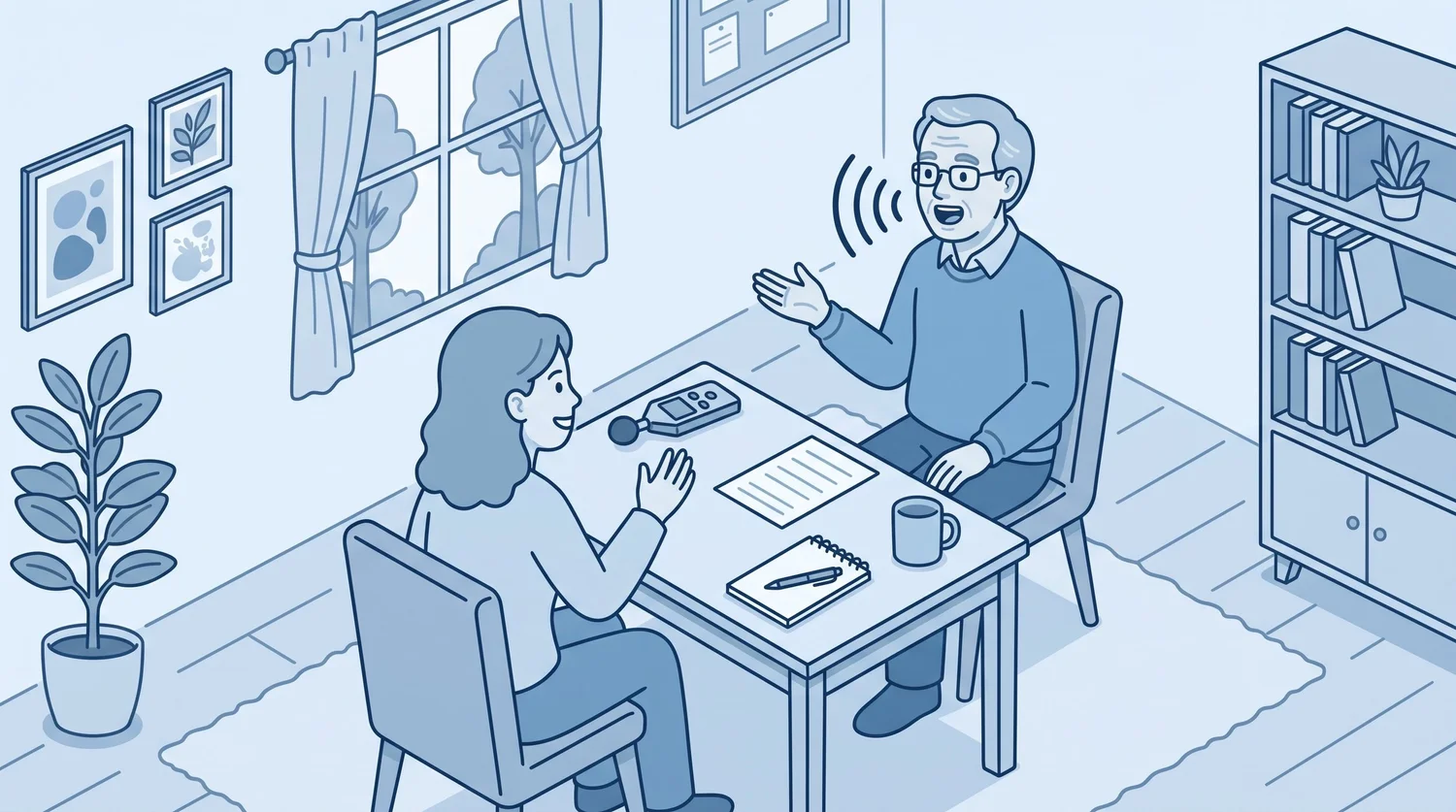
A comprehensive evaluation by a speech-language pathologist looks at how communication works in daily life. Voice volume is one part of that picture.
An SLP may assess voice quality, speech clarity, speaking rate, breathing during speech, and how easily other people understand you. The evaluation may also explore word-finding, attention, or other thinking skills that affect conversation.
Your priorities help shape the assessment. Talking with a spouse, participating in a group, and speaking on the phone can place different demands on communication (Goldman et al., 2024).
How can speech therapy help?
Depending on the evaluation, treatment may focus on developing a stronger, clearer voice, improving speech precision, adjusting speaking rate, or learning to recognize when speech is becoming difficult to hear.
Practice should connect to real communication: introducing yourself, ordering a meal, telling a story, or contributing to a family conversation. Some people also benefit from communication supports. Family members can participate by learning helpful cues and ways to make conversations easier (Goldman et al., 2024).
For example, reducing background noise, facing each other, and allowing enough time to respond can make communication less demanding (Parkinson’s Foundation).
SPEAK OUT!®: Practicing Speech with Intent
SPEAK OUT!® is a therapy program developed by Parkinson Voice Project specifically for people with Parkinson’s and related neurological disorders. It emphasizes speaking with intent—bringing deliberate attention to speech to support a stronger, clearer voice. The program combines education, individual therapy, daily home practice, and ongoing group practice (Parkinson Voice Project).
Research is encouraging. A 2020 study involving 40 people with Parkinson’s found improvements in vocal loudness, intonation, voice quality, and self-reported voice-related quality of life following treatment. A follow-up study found these gains were maintained among 35 participants evaluated one year later while participating in ongoing maintenance. These studies were not randomized comparisons against another treatment, so they do not establish superiority over other approaches (Behrman et al., 2020; Behrman et al., 2022).
What about swallowing?
Speech-language pathologists also evaluate and treat swallowing difficulty, called dysphagia. Parkinson’s can affect chewing, moving food through the mouth, and coordinating swallowing. Signs may include coughing during meals, difficulty swallowing pills, longer mealtimes, or unintended weight loss (Parkinson’s Foundation).
Treatment depends on the specific swallowing problem. One option for selected patients is expiratory muscle strength training (EMST), which uses a device to provide resistance during exhalation. A randomized, sham-controlled trial involving 60 participants found improved swallowing safety after four weeks of EMST. This finding supports its use for appropriate patients following assessment; it does not establish that the treatment prevents pneumonia (Troche et al., 2010).
When should you consider an evaluation?
You can ask about speech therapy when changes first become noticeable. Frequent requests to repeat yourself, avoiding conversations, increased effort when speaking, or concerns about eating and drinking are all reasons to discuss an evaluation.
An SLP can identify current needs, establish a baseline, and recommend treatment or monitoring. Because Parkinson’s changes over time, reassessment can help keep care aligned with your communication and swallowing needs (Goldman et al., 2024).
Common questions
Can speech therapy help with Parkinson’s?
Speech therapy can help address the speech and swallowing changes Parkinson’s can cause. Depending on the evaluation, treatment may focus on developing a stronger, clearer voice, improving speech precision, adjusting speaking rate, or learning to recognize when speech is becoming difficult to hear. Practice connects to real communication, like ordering a meal or contributing to a family conversation.
What is SPEAK OUT!®?
SPEAK OUT!® is a therapy program developed by Parkinson Voice Project for people with Parkinson’s and related neurological disorders. It emphasizes speaking with intent, and combines education, individual therapy, daily home practice, and ongoing group practice. Nicholas Raymond is a SPEAK OUT!® Certified Provider.
Does Parkinson’s affect swallowing?
It can. Parkinson’s can affect chewing, moving food through the mouth, and coordinating swallowing. Signs may include coughing during meals, difficulty swallowing pills, longer mealtimes, or unintended weight loss. A speech-language pathologist can evaluate and treat swallowing difficulty, called dysphagia.
When should someone with Parkinson’s see a speech therapist?
You can ask about speech therapy when changes first become noticeable. Frequent requests to repeat yourself, avoiding conversations, increased effort when speaking, or concerns about eating and drinking are all reasons to discuss an evaluation.
Do you offer Parkinson’s speech therapy in Spanish?
Yes. Nicholas Raymond is a bilingual speech-language pathologist, and we see adults with Parkinson’s at our Arvada clinic, serving the Denver metro, in English and Spanish.
References
- Ramig L, Halpern A, Spielman J, Fox C, Freeman K. Speech treatment in Parkinson’s disease: Randomized controlled trial (RCT). Mov Disord. 2018;33(11):1777-1791. doi:10.1002/mds.27460. PMID: 30264896.
- Goldman JG, Volpe D, Ellis TD, et al. Delivering Multidisciplinary Rehabilitation Care in Parkinson’s Disease: An International Consensus Statement. J Parkinsons Dis. 2024;14(1):135-166. doi:10.3233/JPD-230117. PMID: 38277303.
- Behrman A, Cody J, Elandary S, Flom P, Chitnis S. The Effect of SPEAK OUT! and The LOUD Crowd on Dysarthria Due to Parkinson’s Disease. Am J Speech Lang Pathol. 2020;29(3):1448-1465. doi:10.1044/2020_AJSLP-19-00024. PMID: 32421347.
- Behrman A, Cody J, Chitnis S, Elandary S. Dysarthria treatment for Parkinson’s disease: one-year follow-up of SPEAK OUT!® with the LOUD Crowd®. Logoped Phoniatr Vocol. 2022;47(4):271-278. doi:10.1080/14015439.2021.1958001. PMID: 34338571.
- Troche MS, Okun MS, Rosenbek JC, et al. Aspiration and swallowing in Parkinson disease and rehabilitation with EMST: a randomized trial. Neurology. 2010;75(21):1912-1919. doi:10.1212/WNL.0b013e3181fef115. PMID: 21098406.
This article provides general education and does not replace individualized medical evaluation or treatment.
